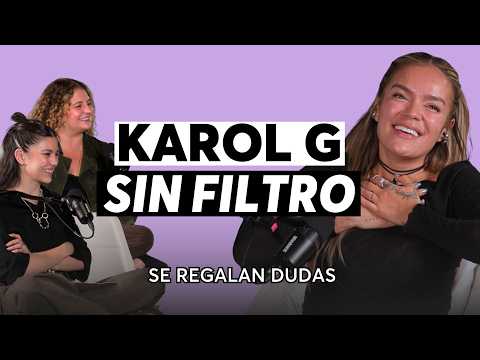
Karol G has built one of Latin urban music’s most recognisable symbols of confidence: La Bichota. It is a name, an attitude and, in her own description, a switch she can turn on when a difficult moment demands extra force. Before walking onstage, she tells herself, “I am La Bichota.” It is armour with excellent lighting.
But in a revealing conversation on Se Regalan Dudas, Karol G makes room for the person under that armour. She speaks candidly about exhaustion, public scrutiny, crying, isolation, the emotional cost of being seen as invincible and the relief of allowing herself to feel without immediately trying to turn pain into a motivational poster.
That is not a retreat from her powerful public identity. It is an expansion of it. And it says something important about a Latin urban scene where emotional directness increasingly has as much cultural weight as bravado.
La Bichota is real—but so is the person who needs a break
Karol G does not frame La Bichota as a fake persona. She describes the figure as part of herself, an alter ego she calls upon when responsibility, fear or the sheer scale of a live show threatens to overwhelm her. In hard situations, she says, that voice tells her she has to keep going.
She has also created another alter ego, Yvonne, associated with the song “Ivony Bonita,” as a psychological source of support in moments when she does not feel capable on her own. The detail is telling: these identities are not masks meant to erase vulnerability. They are tools to move through it.
Still, the singer acknowledges that the balance is complicated. Her public work, close friendships and personal life often overlap; members of her inner circle work alongside her. She enjoys the world she has built, from arriving early at venues to wandering around an arena and taking in the empty seats before the spectacle begins. Yet she also admits she is still looking for more space to care for “Carolina” away from the momentum of the project.
That distinction matters. Pop culture loves a woman who can do everything, preferably while looking unbothered and not sweating through a single sequin. Karol G’s point is sharper: capability does not cancel out the need for rest, privacy or sadness.
Feeling deeply is not a weakness in her latest chapter
At the centre of the conversation is the idea behind her album No Me Arrepiento de Sentir Tanto (“I Don’t Regret Feeling So Much”). Karol G says she had become so invested in the image of the powerful woman who could handle anything that she was repressing emotions she needed to process.
She describes taking a pause from the noise around her in order to understand those feelings rather than simply overpower them. The result, she says, was a body of work that lets anger, abandonment, confusion, sadness and longing exist without disguising them as triumph. Sometimes resilience arrives later. First, there is the inconvenient business of actually feeling the thing.
“The most beautiful thing one can do is feel,” Karol G says in the interview, presenting emotional openness not as a slogan but as a way of being fully present for both joy and pain.
It is a compelling evolution for an artist whose songs have accompanied audiences through heartbreak, confidence and celebration. Her message is not that pain is glamorous—anyone who has cried over a voice note at 2 a.m. knows it is mostly just dehydrating—but that avoiding pain can also mean avoiding the depth of life around it.
She puts it in practical terms: if the price of an extraordinary experience is missing it later, perhaps that is still a price worth paying. The alternative is emotional self-protection so strict that it starts shutting out the experiences one wanted in the first place.
When a song becomes a shared emotional language
Karol G repeatedly returns to her fans, not as a distant audience or a convenient metric, but as part of an exchange. She says letters from listeners have shown her how songs can give people words for feelings they cannot easily explain on their own. That is why releasing personal material feels both frightening and necessary.
For her, a record is only half-finished when it leaves the studio. The other half happens when it reaches someone else and becomes attached to a memory, a breakup, a friendship, a night alone in a bedroom or a packed arena singing at full volume. This is a familiar mechanism in urban music, where songs often function as both personal diary entries and collective rituals.
Her relationship with her audience also complicates the usual celebrity narrative. Asked who supports the person constantly described as helping others, she mentions her family and friends, then adds that her fans also sustain her. Their letters and the direct energy of a live crowd, she says, remind her that the connection goes both ways.
That reciprocity helps explain why vulnerability has become so central to her artistic identity. It is not simply confession for confession’s sake. It is an invitation for listeners to recognise their own stories without pretending they have everything under control.
The public opinion machine still hurts
For all the warmth of that connection, Karol G is direct about the other side of visibility. “Everything has been said about me,” she notes, adding that it still hurts. Recognition does not magically turn criticism into a harmless breeze; it just gives the breeze a larger comment section.
She reflects on how social platforms can create narratives about people who have chosen to share less of their private lives. In her view, online commentary often says more about the person posting it than the person being discussed. But she does not romanticise detachment. Understanding that dynamic, she says, does not mean it stops affecting you.
Her response is to return to intention: why she made the work, how much it demanded and whether she gave it everything she had. This applies to the discipline behind a demanding live show as much as it does to releasing emotionally exposed songs. The outside world can judge the finished surface; only the artist knows the full cost of the process.
She also advocates stepping away from social media, describing a period without it as a reset that helped her reconnect with ordinary life. Her proposal is refreshingly unglamorous: take a few days off, pay attention to what is physically around you and remember that the internet’s constant noise is not the whole planet.
A stronger version of strength
The conversation’s most useful idea may be Karol G’s rejection of the false choice between strength and softness. She can train for a nearly three-hour show, command an arena and still say she is tired. She can be disciplined, ambitious and highly aware of the pressure on women’s bodies while acknowledging that confidence is not a permanent setting.
Her comments on appearance are especially grounded. She says no version of a woman’s body will ever satisfy every outside opinion, and that the crucial work is protecting what one thinks of oneself. It is not a neat solution to a brutal beauty culture, particularly one sharpened by filters and endless comparison. But it is a necessary refusal to let the crowd write the entire script.
Near the end of the interview, Karol G describes her emotional state as spring: a season of flowering after a more enclosed period. It is a fitting image for an artist who has made power look spectacular, but now insists that growth can be quieter, messier and more honest. La Bichota is still there. She just has more room to feel.